The 6 Best Grab Bars for Showers in 2026
Verified weight ratings, ADA diameter checks, and clear picks for every wall, tub, and no-drill situation, with the one safety rule that matters more than any product.
Quick Picks
Jump to the full review of any pick below.
| Grab Bar | Price | Weight Rating | Mount | Diameter | Best For |
|---|---|---|---|---|---|
| Moen Home Care 24″ Peened View on Amazon |
$28.03 | 500 lbs (studded) | Screw-in wall | 1.25″ | The main shower or tub wall bar |
| ZUEXT 16″ Knurled (2-Pack) View on Amazon |
$27.54 | 500 lbs (studded) | Screw-in wall | 1.0″ | Outfitting two spots on a budget |
| Moen 16″ Angled View on Amazon |
$37.39 | 500 lbs (studded) | Screw-in wall | 1.25″ | Sit-to-stand and seat transfers |
| Stander Security Pole View on Amazon |
$169.00 | 300 lbs | Tension floor-to-ceiling | Curved grip | No-drill support by bed or toilet |
| Vaunn Adjustable Tub Rail View on Amazon |
$39.99 | 300 lbs | Clamp-on tub wall | Foam grip | Getting in and out of the tub |
| CIVJET Suction Bars (2-Pack) View on Amazon |
$35.00 | Balance aid only | Suction cup (removable) | Contoured grip | Travel and light steadying |
A grab bar is the single most effective bathroom safety upgrade for anyone at risk of a slip, and the bathroom is where most home falls happen. The hard part is not choosing a brand. It is matching the bar to your wall, mounting it correctly, and understanding that the number printed on the box only holds if the bar is installed the right way.
This guide covers six bars across every common situation: a permanent screw-in bar for the shower wall, a budget two-pack, an angled bar for standing up from a shower seat, a no-drill tension pole, a clamp-on rail for the tub edge, and a removable suction bar for travel. Every weight rating below was checked against manufacturer documentation, and every bar diameter was verified against the ADA range, because one of these picks falls below it and the listing still calls itself ADA compliant.
Before the picks, read the one rule that matters more than any product choice.
A 500 lb grab bar reaches that rating only when it is screwed into a wall stud or solid blocking, or set with the manufacturer’s proper anchors. Mounted into drywall with hollow-wall anchors alone, the same bar can fail under a fraction of that load. A fall also multiplies the force on a bar well beyond your standing body weight, which is why the rating matters even for a lighter person. Find the studs, mount into them, and never trust a primary support bar to drywall anchors alone. Suction bars are not fall-support devices at any advertised number.

Moen Home Care 24″ Peened Grab Bar (R8724P)
The bar to put on your main shower or tub wall. It hits every mark that matters for a primary support bar: an ADA-spec 1.25″ diameter, a 500 lb rating when mounted into a stud, a slip-resistant peened surface, concealed screws, and Moen’s lifetime warranty.
500 lbs when studded
1.25″ (within ADA range)
24″, extends 3″ from wall
304 stainless steel, 20-gauge
SecureMount, any stud angle
Peened, slip-resistant
ADA compliant, Made in USA
Moen Limited Lifetime
Moen’s Home Care line is what most occupational therapists reach for when a client needs a permanent bar, and this 24″ peened model is the version to buy. The peened finish is a fine dimpled texture rolled into the steel itself, so the grip holds up with wet or soapy hands and there is no coating to wear off. The 1.25″ diameter sits right at the bottom of the ADA range, which is the sweet spot for a full-hand grip that most adults can close around comfortably.
The SecureMount system lets you drive the concealed screws into a stud at any angle, so you are not forced to mount horizontally just because that is where the framing runs. That flexibility matters in a real bathroom, where the stud you want rarely lines up with the height you need. Mounting hardware is included, and the screw heads hide under snap-on covers for a clean finished look.
What to Know Before Buying
The 500 lb rating assumes the bar is anchored into a stud or solid blocking. Where there is no stud behind the tile, Moen’s SecureMount anchors carry the load, but they are sold separately, so add them to your cart if your layout needs them. For a primary shower bar, run it horizontally along the long wall at roughly 33 to 36 inches off the floor, which is the reach most people can use to steady themselves or pull up. The most common installation mistake is mounting too high, which robs you of leverage exactly when you need it.
Find the studs with a magnetic stud finder before you commit to a bar location, then mark both ends. If the spot you want lands between studs, this is where the SecureMount anchors earn their keep. When in doubt on a tiled wall, a handyman or an occupational therapist can confirm placement in a single visit, which costs far less than a fall.

Moen 16″ Angled Grab Bar (RA8716D1GBN)
An angled bar follows the arc your hand travels as you go from sitting to standing, so a single grip supports the whole motion. It is the bar to add next to a shower seat or beside the toilet, where straight bars leave a gap in the middle of the movement.
500 lbs when studded
1.25″ (within ADA range)
16″, angled
Stainless steel
SecureMount, any stud angle
Brushed nickel
ADA compliant
Moen Limited Lifetime
This is a companion to the straight 24″ bar above, not a replacement for it. Where a horizontal bar is best for steadying yourself along a wall, the angled bar shines at the specific job of pushing up from a seated position. Mounted with the low end near the seat and the high end toward the standing position, it keeps your wrist in a strong, natural line through the transfer. It shares the same 1.25″ ADA-spec diameter and 500 lb studded rating as the straight Moen, in a brushed nickel finish that blends with most modern fixtures.
What to Know Before Buying
Fit is everything with an angled bar, and this one draws a higher return rate on Amazon than the straight model, almost always because it was mounted at the wrong height or angle for the user. Measure the seat height and the user’s comfortable reach before you drill, and mount into a stud so the 500 lb rating holds. Placed and anchored correctly, it does a job no straight bar can match. If you are unsure of the geometry, this is a good bar to have a professional site and set.

ZUEXT 16″ Knurled Grab Bar, 2-Pack
Two stainless bars for close to what a single premium bar costs, which makes this the value pick for outfitting more than one spot at once. There is one caveat to weigh before you buy: the diameter runs thinner than the ADA range.
500 lbs pull force when installed
1.0″ (below ADA 1.25″–1.5″)
16″ each
2-pack
304 stainless, knurled grip
Concealed screw, any angle
Chrome
Screws, anchors, stick-on hook
Most bathrooms need more than one bar, and buying them one premium unit at a time adds up fast. The ZUEXT two-pack solves that: for roughly the price of a single Moen, you get a pair of 304 stainless bars with a knurled grip surface that bites well when wet. For secondary locations, a bar by the toilet plus a bar at the shower entry, the value here is hard to beat.
The trade-off is diameter. These bars measure 1.0 inch across, below the ADA-recommended range of 1.25 to 1.5 inches, even though the listing markets itself as ADA compliant. A thinner bar is harder to hold securely for someone with a weak or arthritic grip, because the hand cannot wrap it as firmly. For a strong-handed user who mainly wants steadying points, the difference is minor. For a primary support bar carrying real body weight, choose the 1.25″ Moen instead and keep the ZUEXT pair for lighter-duty spots.
What to Know Before Buying
Reviewers note the concealed-screw mounting can be fiddly to line up, so take your time marking the holes. Like every screw-in bar here, the 500 lb figure is a pull-force rating that only holds when the bar is anchored into a stud or solid blocking. Do not treat the included drywall anchors as a substitute for hitting the framing on a bar you plan to lean your weight on.
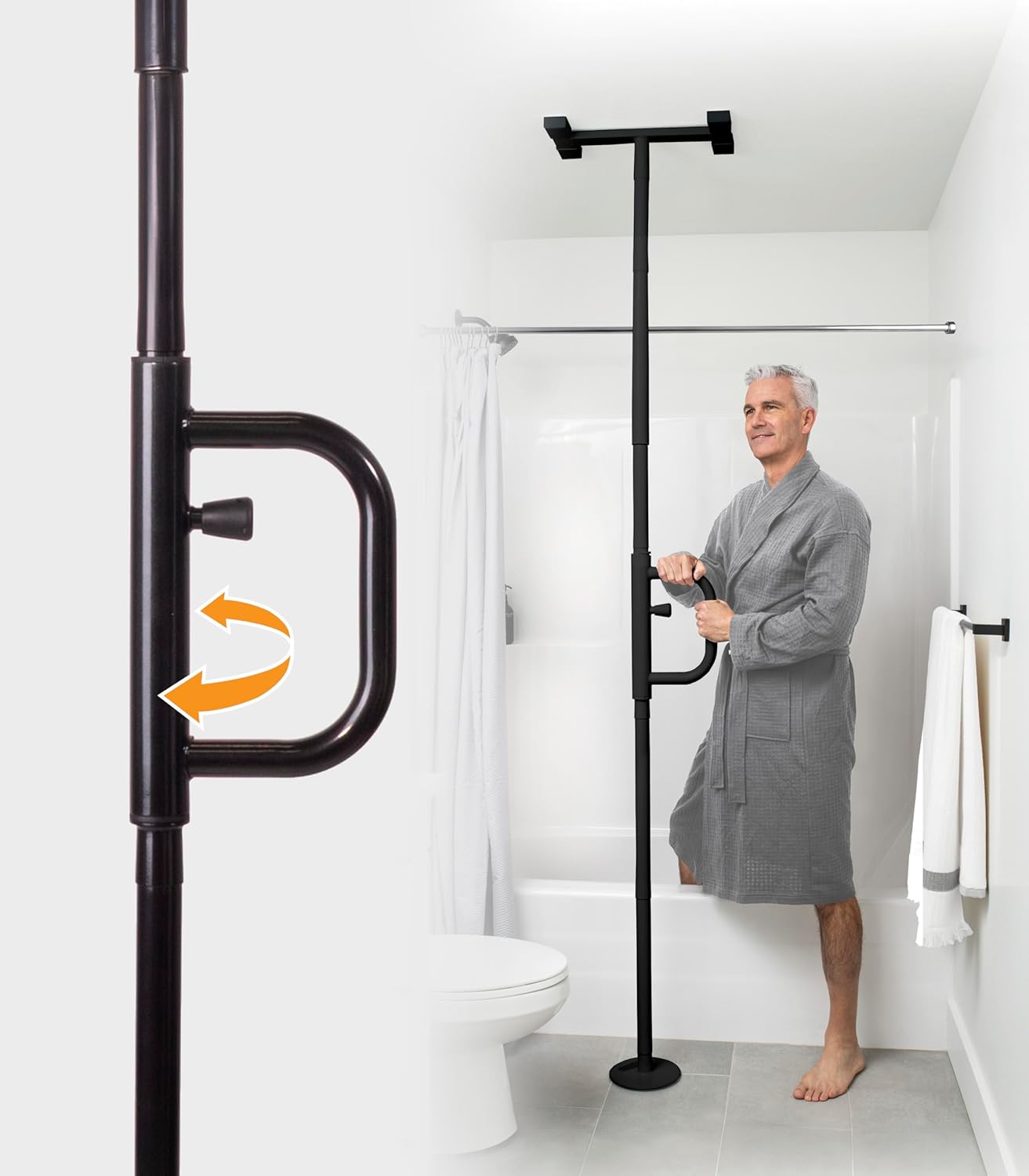
Stander Security Pole & Curve Grab Bar
A floor-to-ceiling pole that wedges into place under tension, no drilling required. The pivoting curved handle gives four hand positions and locks in eight spots, so it is the no-drill answer beside a bed, chair, or toilet where a screw-in bar is not an option.
300 lbs
Tension floor-to-ceiling, no screws
7 ft to 10 ft (flat)
Pivots 360°, locks every 45°
Zinc-plated steel, powder-coat
Eligible
Metallic black
Stander Lifetime Limited
For renters, or for anyone who cannot or does not want to drill into tile, the Stander pole is the strongest no-drill option in this guide. It clamps between floor and ceiling with a padded base and top beam that protect both surfaces, and the curved grab bar pivots a full circle and locks every 45 degrees, so you can angle it exactly where your hand needs it for standing up or transferring. It separates into two pieces for moving, which suits anyone who expects to take it along.
At the top of this guide on price, it is still a fraction of the cost of a professional grab-bar installation, and it goes up in minutes with no tools. Stander includes optional hardware to hard-mount the base and beam if you want extra security in a permanent spot.
What to Know Before Buying
Two limits matter. First, its 300 lb rating is lower than the studded screw-in bars, so it is not the pick for a heavier user who needs the highest capacity. Second, Stander does not recommend installing it inside a shower stall, so treat it as a standing and transfer aid placed beside the toilet, bed, or the outside of the tub rather than a wet-shower bar. It needs a flat, solid ceiling to hold tension; it will not work under a sloped or drop-tile ceiling.

Vaunn Adjustable Bathtub Clamp Rail
Getting a leg over a tub wall is one of the riskiest moves in any bathroom. This rail clamps onto the tub’s side wall with no tools and gives you a solid, height-adjustable handle right at the point of the step. It is the best no-drill assist for tub entry, with one hard limit on which tubs it fits.
300 lbs
Tool-free clamp, no drilling
3″ to 7″ thick
17″ to 20″, adjustable
Under 6 lbs, portable
Powder-coated stainless
Eligible
Soft foam, ambidextrous
The Vaunn rail addresses the exact moment most tub falls happen: the step in and the step out, when one foot is over the wall and your balance is on a single leg. A padded rubber clamp locks onto the tub wall and holds a vertical handle you can grip through the whole transfer. The handle height adjusts across a 17 to 20 inch range, so you can set it for your reach, and the whole thing weighs under six pounds and moves to another tub in seconds.
What to Know Before Buying
The clamp needs a flat, rigid tub wall to bite on, and that is the deciding factor. It is the pick for a standard acrylic or steel tub with a straight, firm rim. It is not made for fiberglass, curved, angled, or textured tub walls, and mounting it on one of those is by far the most common reason it gets returned. Measure your tub-wall thickness against the 3 to 7 inch clamp range and confirm the surface is flat before ordering. On the right tub it is excellent; on the wrong one it will not hold.
A clamp-on rail is only as safe as the tub wall it grips. Do not use this on fiberglass, curved, angled, or textured surfaces, and always push and pull hard to test the clamp before putting weight on it. If your tub wall is not flat and firm, choose a stud-mounted bar instead.

CIVJET Suction Cup Grab Bars, 2-Pack
Removable suction bars have a real, narrow use: a steadying handhold on a smooth tile wall, or a grab point you can pack for a hotel or a family member’s home. They are useful for confidence and light balance. They are not, at any advertised number, a device that will catch you in a fall.
Balance aid only, not fall-rated
Dual suction cups, locking latches
Smooth, non-porous only
2-pack
Yes, no marks, reusable
Not compliant
Used for what they are, these are handy. The cups press onto a smooth surface and lock with latches, and they peel off clean, so they travel well and suit a renter who wants a temporary handhold. On a large, intact tile or a glass panel they hold well enough to steady you as you shift your weight or move in and out of the tub, and owners who understand the limits are happy with them.
The weight claims are where caution comes in. The listing headlines “up to 500 lbs,” yet the same listing’s own product video also shows “up to 200 lbs,” so the number is not one you can rely on. More telling are the owners themselves: the most useful reviews describe these as a handle to help you keep your balance, not something to hold you up if you start to fall, and several report a cup letting go without warning. That is the correct way to think about any suction bar.
What to Know Before Buying
Suction works only on a smooth, non-porous surface: a large tile over 4 inches, glass, or acrylic. It will not hold on textured tile, across grout seams, or on porous or painted walls. Suction also weakens with heat, humidity, and soap, which is exactly the shower environment, so press and pull-test both cups before every single use. If the person using it needs something that will stop a fall, that is a stud-mounted bar, not this. Keep the CIVJET for travel and light steadying, and pair it with a real bar at home.
Consumer safety guidance and the ADA are consistent: suction-cup bars are steadying aids only and are never rated to bear full body weight or arrest a fall, whatever number a listing prints. Suction can release with humidity, soap, or a temperature change, so pressure-test the bar before each use and never rely on it as your only support. Anyone at real risk of falling needs a bar mounted into a stud.
How to Choose a Grab Bar for Your Bathroom
Start with where the risk is
Most bathrooms need more than one bar, and the right places are the spots where balance is hardest: stepping in and out of the tub or shower, standing up from a shower seat or the toilet, and turning around on a wet floor. Walk through the room and note where you reach for the wall or the towel rack today. Those are the points that need a bar. A common setup is a horizontal bar on the long shower wall, a vertical or angled bar at the entry, and a separate assist at the toilet.
Match the mount to your wall
The mount matters as much as the bar. A screw-in bar anchored into a stud is the strongest and the only type suited to catching real weight, which is why both Moen picks and the ZUEXT lead this guide. If you rent or cannot drill into tile, a tension pole or a clamp-on rail gives you solid no-drill support at a lower weight rating, placed outside the wet shower area. Suction bars sit in their own category: useful for steadying and travel, never for fall support. Decide which of those three situations you are in first, and the choice narrows quickly.
Bar diameter and the ADA range
The width of the bar decides how securely a hand can close around it. The ADA range is 1.25 to 1.5 inches, which most adults, including those with a weaker or arthritic grip, can grasp firmly. A thinner bar, like the 1.0-inch ZUEXT, is harder to hold under load, which is why it belongs at secondary steadying points rather than as a primary support bar. It is worth knowing that ADA specifications apply as a legal requirement only to commercial and public buildings. A private home is not required to meet them. They remain the best available guidance for a safe residential install, so this guide treats the ADA numbers as the recommended target rather than a mandate.
Mounting height and placement
For a horizontal bar along a shower or tub wall, 33 to 36 inches off the floor suits most people, matching the ADA guidance. Leave at least 1.5 inches of clearance between the bar and the wall so a hand can wrap it without scraping. The single most common mistake is mounting a bar too high, which reduces your leverage exactly when you are trying to pull up or steady yourself. When you are unsure of placement, an occupational therapist or an experienced installer can set the right height and location in one visit.
No grab bar is safer than its anchoring. A bar rated for 500 lbs delivers that only when it is fastened into a stud or solid blocking. If you take one thing from this guide, find the framing behind your wall and mount into it, or use the manufacturer’s proper anchors, and test the bar hard before you rely on it.
Does Medicare or Insurance Cover Grab Bars?
Original Medicare, Parts A and B, generally does not cover grab bars. Medicare classifies them as comfort and convenience items rather than durable medical equipment, so the cost usually falls to you. This is different from a lift chair, where Medicare may cover the lift mechanism portion with a doctor’s prescription. For how that narrower coverage works, see our guide on whether Medicare covers lift chairs.
There are a few ways the cost can still come down. Some Medicare Advantage, Part C, plans include an over-the-counter benefit or a home-safety allowance that may cover bathroom safety items, so it can be worth checking your specific plan’s catalog. Many grab bars are also eligible for purchase with a flexible spending account or health savings account, and both the Stander pole and the Vaunn rail in this guide are listed as FSA and HSA eligible. Coverage rules vary by plan and change over time, so confirm the details with your provider or plan administrator before you count on any of it.
How We Evaluated These Grab Bars
We verified every weight rating, bar diameter, and mounting spec in this guide against manufacturer documentation and multiple independent retailer listings, and we resolved the current price, product variant, and affiliate details on the live Amazon listing for each pick before publishing. Where a listing’s claim conflicted with the manufacturer’s own materials, we used the conservative, manufacturer-consistent figure, which is why the ZUEXT diameter is reported at 1.0 inch and the CIVJET weight claim is flagged as unreliable rather than repeated at face value.
We do not have physical samples of these bars. Our evaluations draw on documented specifications, manufacturer safety guidance, ADA and consumer-safety standards, and verified owner reviews rather than personal installation. For a category where a spec error is a safety risk, we prioritized checking the numbers over describing a hands-on impression.
Prices shown were accurate at the time of research and change frequently. The comparison table and the buttons reflect the most recently verified prices. Use the links to check current pricing on Amazon.
Frequently Asked Questions
How much weight can a grab bar actually hold?
A quality screw-in bar is rated to 500 lbs, but that figure only holds when the bar is anchored into a wall stud or solid blocking, or set with the manufacturer’s proper anchors. Mounted into drywall with hollow anchors alone, capacity drops sharply. A fall also loads a bar with far more than your standing weight, so treat the 500 lb rating as the reason to install carefully, not as a cushion that lets you skip finding the studs.
Do grab bars have to be ADA compliant in a home?
No. ADA requirements apply as law to commercial and public buildings, not to private residences. You are free to install any bar you like at home. That said, the ADA specifications, a 1.25 to 1.5 inch diameter, a 250 lb minimum support rating with 500 lbs as the home gold standard, and a 33 to 36 inch mounting height, are the best available guidance for a safe install, so it is smart to follow them even though no one requires it.
Are suction cup grab bars safe?
Only for what they are designed to do, which is light steadying and balance on a smooth, non-porous surface. Suction bars are not rated to bear full body weight or to stop a fall, regardless of the number on the package, and their hold can weaken with humidity, soap, or a temperature change. They are a reasonable travel or temporary aid if you pressure-test them before each use. For anyone at real risk of falling, a bar mounted into a stud is the safe choice.
Can I install a grab bar without drilling into the wall?
Yes, with the right no-drill product for the spot. A tension pole like the Stander gives floor-to-ceiling support beside a bed or toilet, and a clamp-on rail like the Vaunn assists tub entry, both without screws. Each carries a lower weight rating than a studded bar and has placement limits, so they suit renters and temporary needs rather than a primary wet-shower support bar. Suction bars are no-drill too, but only as a light balance aid.
Where should grab bars go in a shower or tub?
Put a horizontal bar along the long wall at 33 to 36 inches off the floor for steadying, add a vertical or angled bar at the entry to help with the step in and the sit-to-stand, and place a separate assist at the toilet if that is a hard spot. Leave at least 1.5 inches between the bar and the wall. Mounting too high is the most common error, so err toward a height you can reach with a relaxed arm rather than one you have to stretch for.
Does Medicare pay for grab bars?
Original Medicare generally does not, because grab bars are treated as comfort or convenience items rather than durable medical equipment. Some Medicare Advantage plans include an over-the-counter or home-safety allowance that may apply, and many bars are FSA and HSA eligible. Coverage varies by plan and changes over time, so check with your provider or plan administrator before relying on it.